Menu
Learning to Trust Yourself:
Key Takeaways
- Trust Your Interoception: Your body provides constant, valuable feedback through physical sensations like a tight stomach or heavy chest, which should be prioritised over external data points.
- Intuition vs. Anxiety: True intuitive knowing is calm and grounded, whereas trauma-based anxiety often feels urgent and reactive; learning to distinguish between the two is vital for healing.
- Avoid Outsourcing Regulation: Relying on external experts or digital gurus to dictate your well-being can lead to chronic comparison and a loss of personal agency, or ‘somatic sovereignty.’
- Holistic Integration: Real health considers the whole person – including life stressors and nervous system regulation – rather than treating the body as a broken machine that only requires technical fixes.
About a year ago, I started working with a hormone health coach. I will leave her unnamed, but I can say this with certainty: the experience was not a good one.
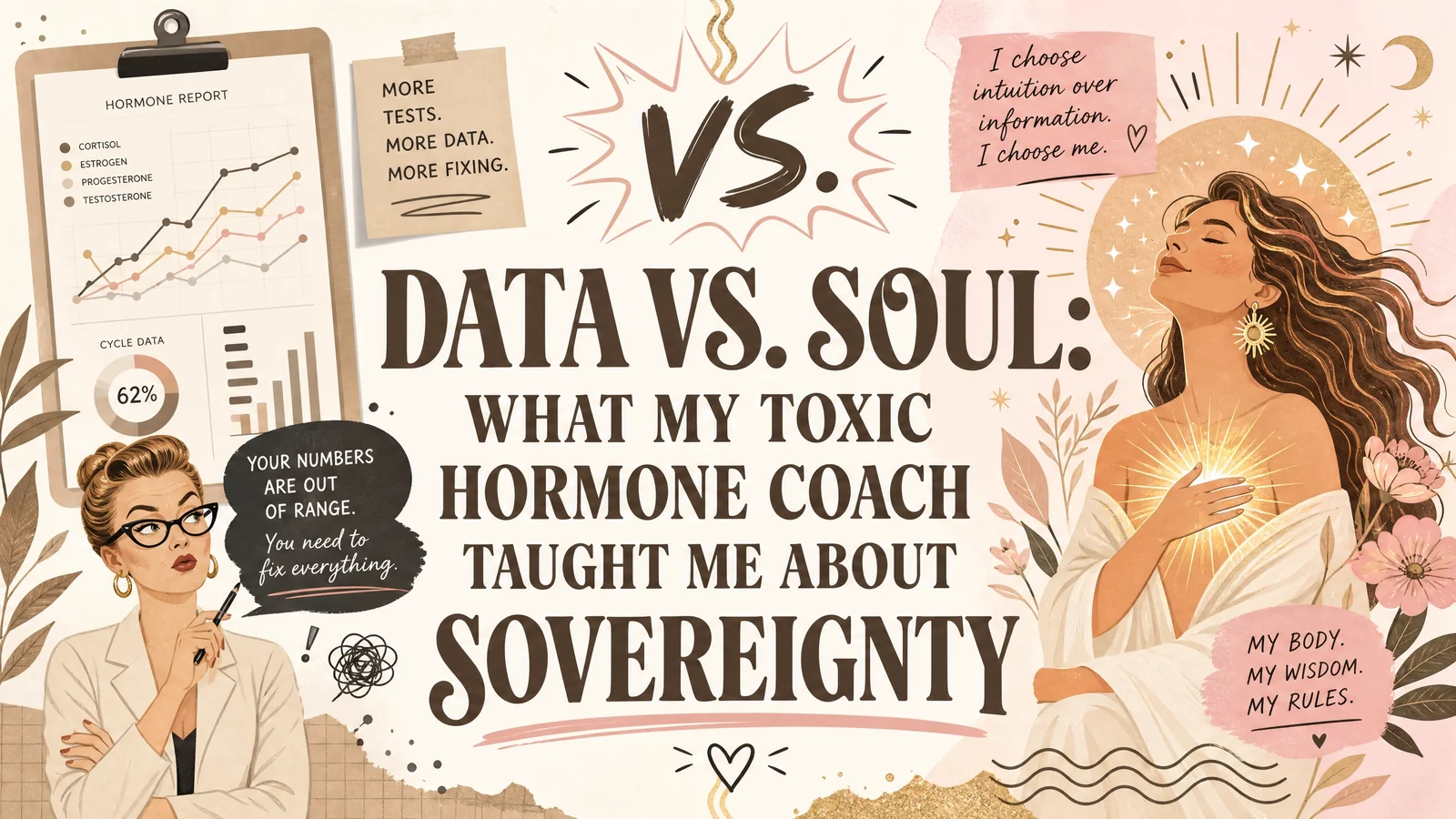
She knew her science. She had the charts, the protocols, and the answers ready. Yet, as the sessions went on, I felt a significant disconnect between her data-driven approach and my own somatic awareness. My concerns were brushed aside, and at times, my own reflections were used against me. After I completed an online quiz she had requested, she used my answers about my parents to dismiss my concerns about her. In effect, she told me that my intuition was just unresolved trauma, a classic sign that her practice lacked the nuance of trauma-informed care.
My stomach tightened. I knew something was wrong. Still, I pushed those body sensations down and carried on, which is a pattern I know far too well.
Somatic Awareness and Your Sovereignty
In the end, I reached the point where I could not ignore myself any longer. It felt as though she wanted data more than honesty. She paid little attention to what I was feeling or to what was happening in my life, even though those external stressors have a direct effect on hormones. If I asked a question, I was met with a dismissive gesture. She gave me a diet plan aimed at my goal weight, even after I explained that I had struggled to lose weight for years, no matter what I ate or how much I exercised.
She wanted me to track my cycle and monitor my basal body temperature, eventually deciding there was probably something seriously wrong with my thyroid. There was not. I had to photograph my meals and log them in an app she never seemed to check. That alone brought up old disordered eating patterns and a sense of emotional dysregulation that I had worked hard to leave behind.
Then there was the time she asked me to co-host a Zoom call so I could show her something on my screen. While I was there, I saw that she had let someone else into the waiting room and was messaging them, even though she had said we had an hour together. I had cleared that time for our work. In reality, I received about 30 minutes. After that, I cut the cord.

Why did I ignore my gut?
Afterwards, I kept turning the experience over in my mind. Why had I stayed so long in something that made me feel small, unseen, and unheard? Was it her large Instagram following or her polished stories? I started comparing myself to everyone else and became obsessed with having the “perfect” cycle. That kind of thinking is corrosive. It pulled me away from the strength of my mind-body connection and toward the noise of the wellness world, where it becomes easy to forget what you actually want.
I was essentially looking for nervous system regulation from an outside source rather than cultivating it within myself. I focused solely on data and in the process I experienced intense shame about my symptoms, which heightened nervous system dysregulation.
The Illusion of Certainty vs. Your Autonomic Nervous System
I ignored what my body already knew and the quiet push from my own intuition, my own form of clairsentience, which kept telling me to walk away. I stayed anyway. This was familiar pattern for me. I believe one of the most harmful parts of modern wellness is that it is loud and glossy. It tells you that the perfect life is within reach if you follow the right guru, but it fails to address your autonomic nervous system or the internal work required for genuine trauma healing.
Your body is not a broken machine waiting for repair. Your feelings are signals and information. My tight stomach was not random; it was a clear message regarding my interoceptive awareness. Somatic psychology starts with those small signals we are taught to ignore. These body sensations include:
- A heavy chest
- A clenched jaw
- A sinking feeling in the gut
- A racing heart
These are not trivial details. They are part of how we know whether something feels safe or wrong, proving the depth of the mind-body connection.
Distinguishing Intuitive Knowing from Trauma-Based Anxiety
It is helpful to distinguish between frantic, trauma-based anxiety and true intuitive knowing. Trauma often screams with a sense of urgency, pulling us into a reactive state. In contrast, intuitive knowing feels calm, grounded, and quiet. Recognising the difference is a vital step in any journey of trauma healing. I had been trained to trust outside authority more than my own senses, believing that an expert could fix my life through a digital screen.
That experience reminded me that real healing does not come from constant external approval. It starts with integrated embodiment, or the process of coming back to yourself. It starts with listening to the body you already have, instead of treating it like a puzzle for someone else to solve.
When I work with clients, I use a framework rooted in somatic therapy. I listen to what is happening in their bodies because they are the experts on their own lives. We build foundations, but the deeper work of guided enquiry is what allows them to reclaim their somatic sovereignty. That is how we learn to trust the messages our bodies give us, even when they clash with the loudest voice in the room.

Frequently Asked Questions
How can I tell if a physical sensation is intuition or just anxiety?
Intuitive knowing usually feels quiet, steady, and grounded, often acting as a calm internal nudge. In contrast, trauma-based anxiety typically presents with a sense of frantic urgency, intensity, and a feeling of being pulled into a reactive state.
Why is it so hard to stop listening to ‘experts’ and start listening to my own body?
Many of us have been socially conditioned to believe that external authorities hold the keys to our health and that our own internal signals are secondary. Breaking this pattern requires consciously reclaiming your somatic sovereignty and recognizing that you are the primary expert on your own life experiences.
What does ‘somatic sovereignty’ actually mean in daily life?
Somatic sovereignty is the practice of trusting your body’s wisdom and maintaining autonomy over your nervous system, even when faced with external pressure or conflicting advice. It means choosing to listen to your internal cues and honouring your body’s signals as a valid form of intelligence rather than outsourcing your self-regulation to others.
Reclaiming your own voice
Coming back to yourself in a culture that keeps telling you what to do is an act of self-respect. It takes time, because we have been taught to override ourselves. We are told to be neat, compliant and data-driven, even when our bodies are asking for something else.
Your hormones are not separate from your nervous system, your stress, your sleep or your life. Your body holds more than numbers on a chart. It holds memory, chronic stress and rhythm too. When you start listening to that wider picture, you stop fighting yourself quite so much.
To begin honoring your internal signals, try integrating these daily self-care strategies. These simple body-based interventions can help you reconnect with your nervous system throughout the day:
- Box breathing: Inhale for four counts, hold for four, exhale for four, and hold for four to regulate your breath.
- Grounding: Press your feet firmly into the floor and notice the support of the ground beneath you.
- Sensory checking: Take a moment to name three things you can see, two you can hear, and one you can feel against your skin.
- Resource tracking: Recall a moment or place that brings you a sense of calm to help stabilise your nervous system.
Daily Self-Care Strategies for Somatic Awareness
Our bodies are intelligent. We are taught to forget that, especially as women. Remembering it again is not indulgent; it is a vital step toward embodied well-being.
If your body has been whispering for a while, start there. Notice the knot in your stomach. Notice the easing. Pay attention to your body sensations to see what makes you feel more like yourself and what leaves you feeling split in two. That is where real clarity begins.
Hormonal Health: Signs you have a Hormonal Imbalance
The Ultimate Guide to Eating and Moving for Your Specific Cycle Phase
Somatic Wisdom vs. The 20-Step Routine
The Luteal Phase: Why do I feel like a different person every three weeks?
Energy Crashes: Understanding Your Body’s Signals
Cycle Syncing: Exercising for Your Cycle to Beat PMS Symptoms
4 Types of PCOS Explained, Symptoms and Causes
How to Support Yourself During the Luteal Phase
Hormonal Health Basics for Women: A Guide
Hormonal Wellbeing: Your Hormonal Happiness
Healthy Habits and Your Hormones: How your everyday habits affect your cycle
Why building Somatic Awareness helps your menstrual cycle
Why Your Nervous System Holds the Key to Hormonal Balance
The Luteal Phase: “I know all this but I can’t move”
An ode to ‘feeling wrecked’ right now
Your Hormones aren’t betraying you
Trauma and Your Hormones: Understanding the Silent Connection
Body Literacy: Let’s stop chasing the ‘perfect’ cycle
The Hormone Powerhouse: A love letter to my liver
My Hormones + Hakomi: The 5 simple principles of Hakomi that overhauled my PCOS
From PCOS to PMOS: A Journey in Understanding my Hormonal Health
Data vs. Soul: What My Toxic Hormone Coach Taught Me About Sovereignty

