Menu
A tale of my luteal phase + doomscrolling
So I’ve spent most of this week lying horizontally doomscrolling through news and images that my brain has failed to really process or digestible. Mainly because they aren’t really processable or digestible. We are living in unprecedented & fucking terrifying times. I don’t want to dwell, but more to ask to why when I am due my period, I seem to be drawn to the endless churn of social media. I find it hard to do anything that constitutes as real self care for myself. I can’t concentrate on films, books, even reading things on Substack. All of it seems to fall off the table.
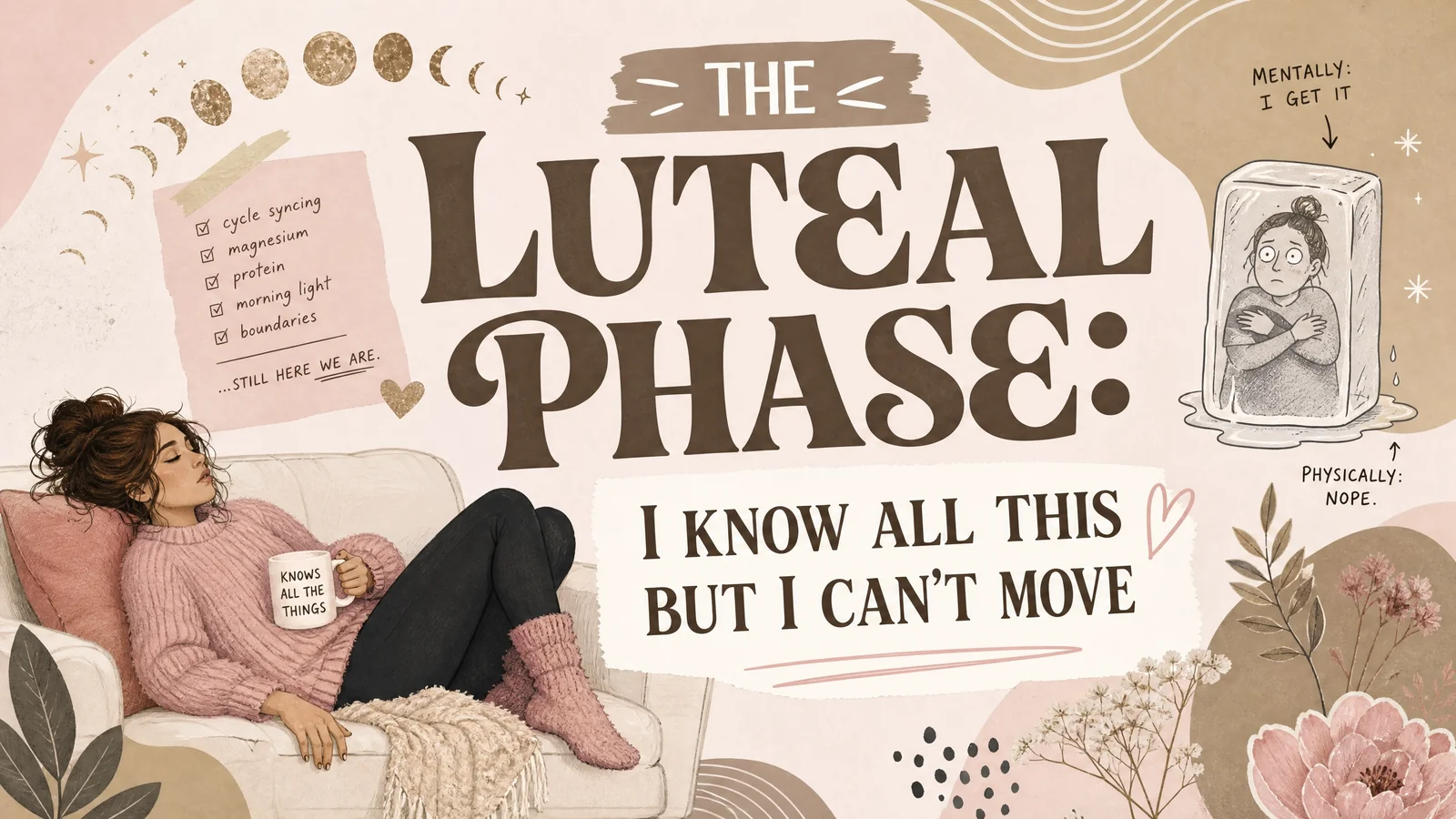
As someone who has studied somatic therapy and hormonal health, I find it puzzling that I can’t employ any of the tools or techniques right before my period. I seem to go into a shutdown/freeze state. I am hyper vigilant. Grumpy. Anxious. And yet, that little social media app seems to scream my name. Take today for example, I woke up at 4am. Did I read? No. Did I meditate? No. Did I journal? No. WHAT DID YOU DO, I hear you ask. I picked up my phone and scrolled for the best part of two hours. I cried at three different videos. One was a elderly man holding a protest sign against ICE, one was of an abused pony and a little boy The luteal phase: when I know what helps, but I still can’t move
Navigating the emotional and physical shifts of the second half of the menstrual cycle.

Key Takeaways
- The luteal phase involves significant hormonal fluctuations, including drops in estrogen and progesterone, which can directly impact neurotransmitters like serotonin and dopamine, leading to mood changes and decreased motivation.
- Reaching for your phone to doomscroll is a common biological response to the fatigue and emotional sensitivity of the luteal phase, as your brain seeks quick, easy hits of dopamine.
- It is common to feel a diminished capacity for complex self-care during this time, making it essential to shift your focus toward simple, manageable maintenance tasks like hydration, fresh air, or changing your sheets.
- Navigating the luteal phase requires grace rather than shame; acknowledging that your capacity for work and stress fluctuates with your cycle helps you work with your body instead of fighting against it.
My week of lying down and scrolling
I have spent most of this week flat out, phone in hand, doomscrolling through news, clips, and posts my nervous system clearly did not want to process. The world feels frightening right now, and I do not want to pretend otherwise. Even so, I keep noticing the same pattern every month within my menstrual cycle. When the luteal phase arrives, I seem to drift straight towards my phone, seeking comfort in a screen.
At the same time, I lose interest in the things that usually help me. I cannot settle into a film. I cannot focus on a book. Even reading something short feels like hard work. Real self-care starts to feel far away, while the endless scroll feels close and easy.
That is what confuses me most. I have studied somatic therapy and hormonal health, so I know the tools. I know the breathing, the pausing, the grounding, and the body-based ways back to myself. Yet, in the luteal phase, it can feel as though my body has gone into shutdown. My emotional state fluctuates, and I find myself becoming snappy, anxious, or tearful. These symptoms are a classic manifestation of premenstrual syndrome, often leaving me feeling frozen and unable to act. My mind wants comfort, but my capacity for anything other than scrolling feels low.
This morning was a perfect example of this common PMS experience. I woke at 4am. I did not read. I did not meditate. I did not journal. I picked up my phone and scrolled for nearly two hours. I cried at three different videos, one about an elderly man holding a protest sign against ICE, one about an abused pony trying to trust a little boy, and one about a girl asking her dad red flag and green flag questions. My emotions were all over the place, and my phone was right there, ready to absorb the lot.

Why the luteal phase makes this harder
There is a very real science behind this. To understand why I feel so sluggish, it helps to look at the cycle as a whole. During the follicular phase, my body is busy developing ovarian follicles, and one dominant follicle prepares to release an egg. This phase is usually marked by rising energy. Once ovulation occurs, triggered by an LH surge and the release of luteinizing hormone, the luteal phase begins.
After ovulation, the empty follicle transforms into the corpus luteum. The primary job of the corpus luteum is to produce progesterone and estrogen to thicken the uterine lining, also known as the endometrium, in preparation for a potential pregnancy. If pregnancy does not occur, the corpus luteum eventually stops producing these hormones, and the uterine lining begins to break down.
It is these falling hormone levels that make the luteal phase so difficult. When oestrogen and progesterone levels drop, I feel less steady. While the follicular phase is defined by rising energy, the luteal phase requires my body to process significant hormonal shifts. If implantation does not happen, these fluctuating hormone levels directly impact my neurotransmitters, especially serotonin and dopamine.
Serotonin helps with mood regulation, while dopamine is tied to motivation and that quick burst of satisfaction I get from something new. When my levels wobble, I am more likely to look for fast relief. That is where doomscrolling comes in. It gives my brain instant stimulation and tiny hits of dopamine. It is not good for me, but it is easy. When I am tired, PMS-y, or overstimulated, easy wins become very tempting. My brain is not trying to ruin my day; it is just trying to feel better fast.
There is also the stress side of it. In the luteal phase, many women feel more reactive to stress and less able to filter out noise. So when the outside world already feels heavy, the urge to check, scroll, refresh, and check again makes perfect sense. It is a short-term habit that gives a brief sense of control, even when it leaves me feeling worse later.
What I do when I notice it
Once I finally put my phone down, I try to be honest about what is happening instead of piling shame on top of it.
I remind myself that I am not lazy or broken. I am simply navigating my luteal phase, a time when hormonal shifts change how my body and brain respond to stress, stimulation, and fatigue. I first started noticing this pattern by tracking my basal body temperature, which gave me the data I needed to anticipate when the transition would occur. Now, I know that the drop in progesterone and the relative decline in estrogen are what make these foundational self-care habits so necessary.
Then I go back to basics. I change my sheets and take a cool shower, which helps soothe inflammation caused by prostaglandins. I try to walk the dogs, even if the weather is miserable. If I have the energy, I do a very light workout, nothing dramatic, just enough to shift my state. I lie with my legs up the wall and play a meditation on Insight Timer. If I cry again later, I let myself cry.
I also try to speak to myself in a way that matches the day I am actually having. Some days are for output, while others are for maintenance. During my luteal phase, maintenance is often enough. Food, water, a shower, fresh sheets, and a short walk are plenty. Understanding the rhythm of my menstrual cycle has taught me that because progesterone levels fluctuate, my capacity for work fluctuates, too. By prioritizing this maintenance during my luteal phase, I am honoring the natural cycle of my body rather than fighting against it.
What I want other women to know
If you are stuck in the same pattern this week, I want you to know that you are not failing at self-care. You are having a human response to the fluctuations of your menstrual cycle, the pressure of stress, and a world that often feels like too much.
It is important to recognize that the hormonal shift following ovulation is a major biological event. During this luteal phase, you may find that your body requires more grace than usual. While some people experience standard PMS, for others, this time of the month can feel much more severe, potentially even reaching the level of PMDD. Regardless of where you land on that spectrum, the luteal phase can make you crave comfort, certainty, and stimulation at the exact time your body has less capacity to handle them.
That does not mean you are doing it wrong. It means you need gentler expectations and smaller, more manageable steps. Sometimes the most caring thing you can do is stop asking yourself for perfection and return to the basics. Please know that simply navigating these changes is enough to get you through the day.

Frequently Asked Questions
Why do I feel more anxious or tearful during my luteal phase?
These emotional shifts are largely driven by the declining levels of progesterone and estrogen after ovulation, which affect your body’s ability to regulate mood-stabilizing neurotransmitters. Increased sensitivity to stress during this window is a normal physiological response to these hormonal changes, making the world often feel more overwhelming than it does during other parts of your cycle.
Is it normal to lose interest in my usual healthy habits during the luteal phase?
Yes, it is completely normal to find that your capacity for demanding tasks or complex self-care routines decreases as your body prioritizes energy conservation. When your dopamine levels fluctuate, your brain may naturally prefer easy, low-effort stimulation like scrolling over more rewarding activities that require higher levels of focus.
How can I practice self-care when I have no energy?
Focus on “maintenance” rather than productivity by tending to basic physiological needs like fresh air, water, and hygiene, which can help regulate your nervous system. Small, low-effort actions like a cool shower or lying with your legs up the wall are often enough to honor your body’s needs without the pressure of perfection.
How do I know if my luteal phase symptoms are part of a larger issue?
While many people experience mild PMS, significant disruptions to your daily functioning may indicate more intense experiences like Premenstrual Dysphoric Disorder (PMDD) or other hormonal imbalances. If you find that your symptoms feel unmanageable or significantly impact your quality of life, tracking your cycle and consulting with a healthcare professional can help you better understand your specific biological patterns.
Hormonal Health: Signs you have a Hormonal Imbalance
The Ultimate Guide to Eating and Moving for Your Specific Cycle Phase
Somatic Wisdom vs. The 20-Step Routine
The Luteal Phase: Why do I feel like a different person every three weeks?
Energy Crashes: Understanding Your Body’s Signals
Cycle Syncing: Exercising for Your Cycle to Beat PMS Symptoms
4 Types of PCOS Explained, Symptoms and Causes
How to Support Yourself During the Luteal Phase
Hormonal Health Basics for Women: A Guide
Hormonal Wellbeing: Your Hormonal Happiness
Healthy Habits and Your Hormones: How your everyday habits affect your cycle
Why building Somatic Awareness helps your menstrual cycle
Why Your Nervous System Holds the Key to Hormonal Balance
The Luteal Phase: “I know all this but I can’t move”
An ode to ‘feeling wrecked’ right now
Your Hormones aren’t betraying you
Trauma and Your Hormones: Understanding the Silent Connection
Body Literacy: Let’s stop chasing the ‘perfect’ cycle
The Hormone Powerhouse: A love letter to my liver
My Hormones + Hakomi: The 5 simple principles of Hakomi that overhauled my PCOS
From PCOS to PMOS: A Journey in Understanding my Hormonal Health
Data vs. Soul: What My Toxic Hormone Coach Taught Me About Sovereignty

