Menu
How to cycle sync
I hear a lot about cycle syncing, which is the idea of adjusting food and exercise to match different parts of your month. I get why it appeals, but I also know it can feel like one more thing to get right.
What helps me is keeping it simple. I treat eating according to your menstrual cycle as a way of noticing what my body asks for, rather than another set of strict rules. That means paying attention to nutrition, rest, your fluctuating energy levels, and the kind of exercising that feels right in each phase.
My cycle affects far more than my period. It also shapes my brain, metabolism, immune system, microbiome, stress response, and reproductive system. When I pay attention to those hormonal shifts, I usually feel more steady and less at war with my body.

Key Takeaways
- Cycle syncing should be a tool for somatic awareness rather than a rigid set of rules, focusing on how your body feels rather than chasing perfection.
- Your menstrual cycle consists of four distinct phases—follicular, ovulation, luteal, and menstrual—each influencing your metabolism, energy levels, and hormonal balance differently.
- Nutrition and movement can be adjusted to support your body’s specific needs, such as choosing high-intensity workouts during ovulation and prioritising restorative, gentle movement during your period.
- Listening to your body’s unique signals, like hunger and fatigue, is more effective for long-term health than strictly following a calendar-based routine.
Pin it for later ⬇️
My four cycle phases
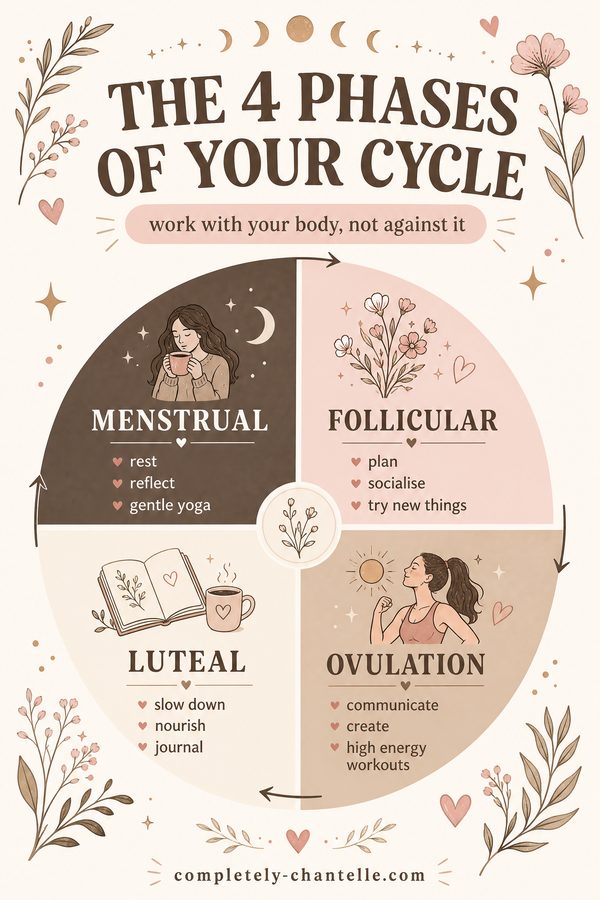
My menstrual cycle is more than just my period and the time in between. It moves through four main phases, and each one brings a different mix of hormones, energy, and appetite. By using cycle tracking, I have learned to identify these shifts to better support my body.
1. Follicular phase, roughly day 1 to 13
The follicular phase starts with my period, so day one of bleeding is the start of a new cycle. At first, estrogen is low, but as my hormone levels begin to rise, my body prepares to release an egg.
At the start, I can feel a bit flat or tired. As estrogen climbs, I often feel clearer in my head and more ready to make plans. My metabolism is usually a little slower here, and I sometimes notice that I am less hungry than usual.
Regarding my diet and nutrition, I keep things light but satisfying. I often choose:
- breakfast with protein and healthy fats
- lunch with fats and plenty of colourful vegetables
- dinner with protein, vegetables, and slow-release carbohydrates
When it comes to exercise routines, this is a good time for me to build momentum. I usually enjoy cardio, longer walks, runs, or trying a new class. My energy is rising, so I use that space for something a bit more upbeat.
2. Ovulation phase, roughly day 14 to 17
This is the part of my cycle where estrogen and testosterone are at their highest. A surge in luteinizing hormone triggers this window, and I usually feel more social, more talkative, and more switched on. Energy often comes more easily.
Because estrogen is peaking, I focus on foods that help my body process it well. I make room for raw and plant-based foods, especially cruciferous vegetables like broccoli, cauliflower, and kale. Fibre also matters here, because it helps with regular digestion and hormone clearance.
For meals, I tend to keep the same steady structure:
- breakfast with protein and healthy fats
- lunch with protein, fats, and vegetables
- dinner with protein, vegetables, and carbohydrates
This is often my strongest window for physical activity. HIIT workouts, strength training, or challenging bodyweight circuits usually feel more manageable here. I can do more in this phase, although I still pay attention to how I actually feel on the day.
3. Luteal phase, roughly day 18 to 28
The luteal phase is the time that often feels the heaviest. Estrogen and testosterone start to fall, progesterone rises, and my metabolism speeds up a little. Resting cortisol can also be higher, so I may feel more sensitive, more inward, or more irritable near the end of this luteal phase.
This is usually when cravings, comfort eating, and premenstrual syndrome symptoms can show up if I am not supporting myself properly. I find that my body often wants more food, not less, and it does better with slow-burning energy. Those managing conditions like PCOS or endometriosis may find they need extra support during this luteal phase.
My nutrition in this phase usually includes more complex carbohydrates, because they help keep blood sugar steadier. Beans, lentils, sweet potatoes, and plenty of vegetables are all useful here, especially cruciferous vegetables.
I usually eat:
- breakfast with protein and healthy fats
- lunch with protein, fats, carbohydrates, and vegetables
- dinner with protein, vegetables, and carbohydrates
When I am exercising in this part of my cycle, I do better with low-impact exercise. Pilates, restorative yoga, walking, and mobility work feel kinder. I also incorporate light strength training, but if I push too hard, I often feel it later. Support matters more than effort in this part of the menstrual cycle.
4. Menstrual phase, roughly day 1 to 7
This is my most restorative phase. Estrogen, testosterone, and progesterone are all at their lowest, and my hormone levels naturally dip while my body sheds the uterine lining.
I treat this menstrual phase as a time for rest, warmth, and simple nourishment. I focus on enough calories and food that feels grounding, including iron-rich foods to help with replenishment. Whether someone prefers a grain-free, paleo, or lower-carb approach, the goal is to manage period symptoms through easy, comforting meals that leave me feeling warm and supported.
I usually prioritise food that feels filling and steady, rather than light or restrictive.
For movement, I keep things very gentle. Slow walks, stretching, yin yoga, or simply resting all make sense here. This is the phase where I remind myself that my body is doing important work, so I do not need to pile pressure on top of it.

Frequently Asked Questions
Is cycle syncing only for people with natural cycles?
While the hormonal shifts are more pronounced in those not on hormonal birth control, the practice of somatic awareness is helpful for everyone. Even if your hormones are influenced by medication, paying attention to your energy, mood, and hunger remains an excellent way to support your overall wellbeing.
Can I still work out if I don’t follow my cycle exactly?
Absolutely. The goal is to avoid feeling like you are at war with your body, not to add more pressure to your routine. If you feel like doing a heavy workout when your cycle suggests rest, listen to your body first and adjust based on your actual energy levels.
How do I start tracking my cycle if I’m new to this?
Start simple by logging your energy levels and mood alongside the first day of your period for a few months. Use a notebook or an app to observe patterns, which will help you understand how your personal cycle behaves before you try to change your habits.
What if I don’t have time to change my diet every week?
There is no need to overhaul your entire kitchen to practice cycle syncing. Focus on one small, sustainable change, like incorporating more iron-rich foods during your period or being more mindful of protein and healthy fats throughout the month.
What I keep in mind
I can make this far more complicated than it needs to be, but I get the best results when I stay present with my body instead of trying to follow every rule perfectly.
Somatic awareness helps here. I pay attention to my hunger, energy, mood, and physical comfort, then I respond with one small choice that supports me. Making this a regular part of my cycle tracking habit allows me to stay grounded. Sometimes that means more food. Sometimes it means less exercise. Sometimes it means a walk, a nap, or an earlier night.
My hormones are not betraying me. They are giving me information.
If I listen to that information, I can make better choices around eating according to the menstrual cycle, daily diet and nutrition, and exercising in a way that suits where I am right now. For those who are on birth control, these hormonal shifts may feel less pronounced or different, but practicing somatic awareness remains an incredibly effective tool for understanding your needs.
If this feels like a lot, I bring it back to one simple question for the week: what does my body need today?
Hormonal Health: Signs you have a Hormonal Imbalance
The Ultimate Guide to Eating and Moving for Your Specific Cycle Phase
Somatic Wisdom vs. The 20-Step Routine
The Luteal Phase: Why do I feel like a different person every three weeks?
Energy Crashes: Understanding Your Body’s Signals
Cycle Syncing: Exercising for Your Cycle to Beat PMS Symptoms
4 Types of PCOS Explained, Symptoms and Causes
How to Support Yourself During the Luteal Phase
Hormonal Health Basics for Women: A Guide
Hormonal Wellbeing: Your Hormonal Happiness
Healthy Habits and Your Hormones: How your everyday habits affect your cycle
Why building Somatic Awareness helps your menstrual cycle
Why Your Nervous System Holds the Key to Hormonal Balance
The Luteal Phase: “I know all this but I can’t move”
An ode to ‘feeling wrecked’ right now
Your Hormones aren’t betraying you
Trauma and Your Hormones: Understanding the Silent Connection
Body Literacy: Let’s stop chasing the ‘perfect’ cycle
The Hormone Powerhouse: A love letter to my liver
My Hormones + Hakomi: The 5 simple principles of Hakomi that overhauled my PCOS
From PCOS to PMOS: A Journey in Understanding my Hormonal Health
Data vs. Soul: What My Toxic Hormone Coach Taught Me About Sovereignty

